海洋热浪指海洋表面温度(SST)持续超过一定阈值的极端高温事件,一般定义为SST至少连续五天超出气候平均态90百分位的极端事件,其在时间上可持续数天至数月,面积可达几平方公里至数千平方公里(Hobday et al., 2016)。
气候变化正改变全球生态系统的结构与功能,海洋上层已吸收了超过90%的人类活动产生的多余热量,因此,在过去40年里,海洋表面温度以平均每十年0.15 °C的速度变暖,全球海洋热含量目前处于历史最高水平(Intergovernmental Panel on Climate Change [IPCC] 2021)。除了全球海表温度的逐渐变暖之外,短期海洋变暖事件——海洋热浪的频率和强度也大幅增加。根据大气热浪研究的经验,Hobday et al. (2016)提出将海洋热浪定性地定义为特定地点的离散长期异常温暖的海水事件,其中“离散”被定义为具有开始和结束日期的可识别事件,“长期”意味着至少持续5天,“异常温暖”被定义为海洋表面温度超过参考阈值。根据参考阈值选择的不同,目前海洋热浪的主要定义方法分为绝对阈值法与相对阈值法:绝对阈值法是将生物所能承受的温度上限或特定时间的温度作为阈值,来识别海洋热浪事件,这一方法更适用于海洋生物生理学研究(图 1a);目前使用更广泛的相对阈值法是通过结合气候平均态来定义热浪事件(图 1b),即使用基于≥30年的气候平均态海表温度计算得到的阈值,因而具有季节变化性,可适用于全年海洋热浪识别(Hobday et al., 2016; Oliver et al., 2019)。
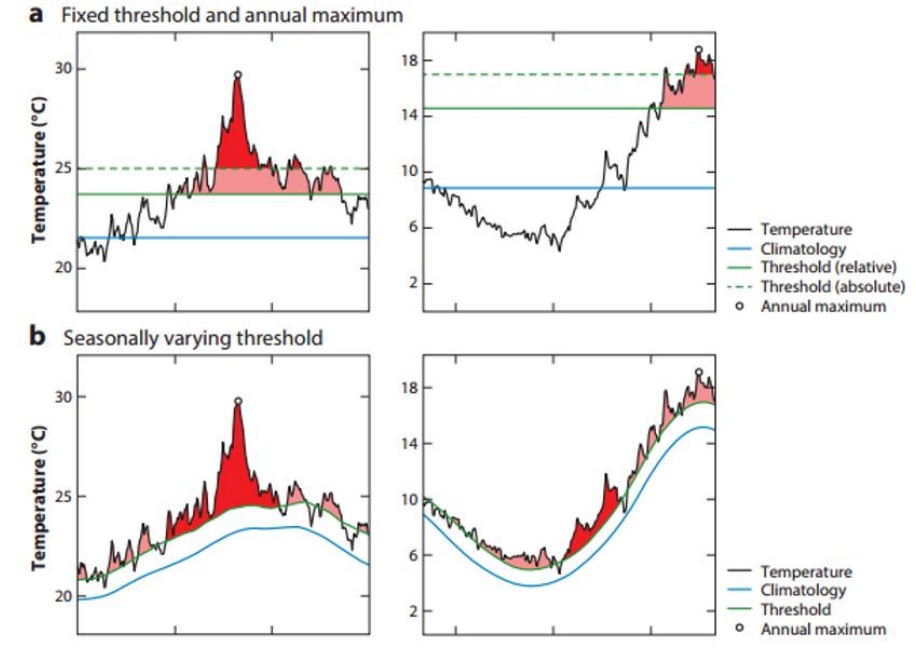
图1 海洋热浪的不同定义方法(Oliver et al., 2021)
海洋热浪对海洋生态系统产生了广泛影响,包括驱动物种种类变化和大规模死亡,改变食物网和物种相互作用等(Smith et al., 2021),导致了生态系统结构和组成的转变,甚至发生不可逆转的变化(Smale et al., 2019; Straub et al., 2019)。在过去十年中,海洋热浪导致海鸟大量死亡(Piatt et al., 2020),物种和主要栖息地类型的丧失,包括海藻林、海草和红树林的退化和死亡(Wernberg et al., 2016; Babcock et al., 2019),渔业减少或关闭(Caputi et al., 2019; Fisher et al., 2021),并造成有害藻华和疾病的爆发(Oliver et al., 2017; Trainer et al., 2020)。Wild et al. (2019)的研究发现海洋热浪会导致海豚的食物减少,并且破坏了它们重要的繁殖地和栖息地,进而导致海豚的生物量和繁殖率降低。Caputi et al. (2016)的研究指出,海洋热浪严重影响了澳大利亚地区的海洋无脊椎动物的生长和生存,导致细菌大量繁殖,致使扇贝、鲍和螃蟹种群数量减少。
珊瑚礁作为世界上最具生物多样性和经济重要性的海洋生态系统,同时也是受海洋热浪影响最大的生态系统之一。海洋热浪表现出的极度温度异常引起珊瑚共生虫黄藻的逃逸与死亡,导致珊瑚白化,长时间的白化事件使珊瑚失去营养供应,最终导致珊瑚的退化或死亡(Douglas, 2003; Hughes et al., 2018; Holbrook et al., 2020)。相关研究表明,仅在大堡礁附近海域,2016年、2017年、2020年以及2022年就发生了由海洋热浪导致的珊瑚重大白化事件(Pratchett et al., 2021);法国Moorea岛在2019年发生了30年来最严重的一次海洋热浪事件,致使全岛大规模珊瑚白化(Speare et al., 2022);2020年夏季,南海经历了严重的海洋热浪事件,导致了大量珊瑚白化(Feng et al., 2022; Mo et al.,2022)。频繁的热浪事件导致不同程度的珊瑚白化事件,进而对整个珊瑚生态系统产生了重大影响,包括珊瑚覆盖率下降、珊瑚群落结构变化以及鱼类群落物种丰富度和生物量减少(Harrison et al., 2019; Burn et al., 2021; Hoey et al., 2021)。研究发现,暴露于快速的升温事件时,珊瑚显示出较高的生理应激(Middlebrook et al., 2008; Martell and Zimmerman, 2021),快速发生的海洋热浪事件意味着短时间内热量的迅速积累,将导致珊瑚等其他对热量敏感生物迅速死亡或健康状况的下降。因此,面对海洋热浪对海洋生态深远且复杂的影响,亟需发展出能够识别与反映快速发生的海洋热浪的特征指标来更好地评估海洋热浪事件对海洋生态系统的危害性。
现有的研究主要通过海洋热浪事件的持续时间、强度、发生频率以及全年热浪总天数等物理属性来描述其基本特征(图2)(Oliver et al., 2018; Holbrook et al., 2019; Hayashida et al., 2020)。结合美国国家海洋和大气管理局最优插值海面温度(NOAA OISSTV2.1)分析数据可对全球多处海域进行热浪探测并计算得到其特征值。该数据集整合了来自不同平台的观测数据,如海洋卫星、船舶、浮标和Argo浮标(Reynolds et al., 2007),覆盖了1981年9月1日至今的连续时间范围,目前已被广泛应用于全球海洋热浪事件变化特征研究(Hobday et al., 2016; Fr?licher et al., 2018; Oliver et al., 2018; Smale et al., 2019; Holbrook et al., 2019; Sun et al., 2024),所有研究结果都表明,近年来全球海洋热浪频率、持续时间以及平均强度等快速增加。研究表明,海洋热浪事件的发生频率平均每年1到3次(Oliver et al., 2018),在赤道东太平洋,热浪事件表现为单个的、持久的极端事件,平均持续时间长达60天(Holbrook et al., 2020);海温变率较大的区域往往发生高强度的海洋热浪,主要集中在边界流区和赤道中东太平洋,这些地区海洋热浪的强度高于 2.5 ℃;海洋热浪的持续时间在热带太平洋东部最长,其他热带地区较短,通常为 5-10 天,在温带地区,热浪持续时间通常为10-15天(Di Lorenzo and Mantua, 2016)。在上个世纪,全球热浪频率和持续时间分别显著增加了34%和17%,热浪天数增加了54%(Oliver et al., 2018)。
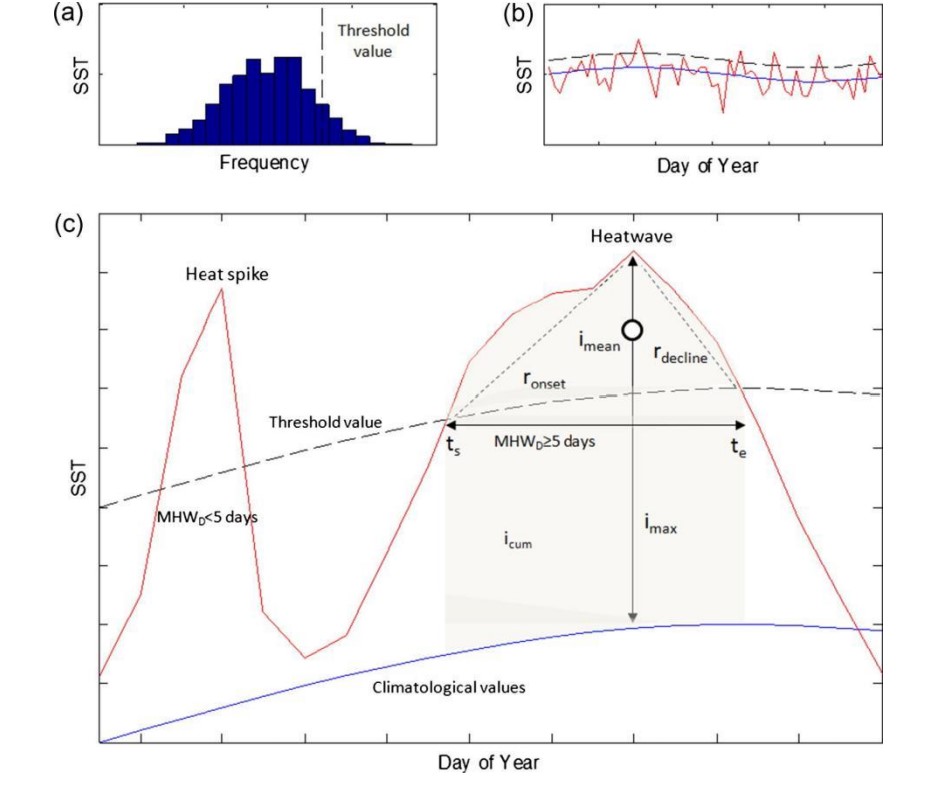
图2 海洋热浪的主要特征(Hobday et al., 2016)
海洋热浪的发生速率与衰亡速率是Hobday et al. (2016)提出的表征热浪强度变化趋势的指标,能反映海洋热浪的极端性质与严重程度,但是目前还未有研究系统地分析全球海洋热浪事件在生命期内的发生速率及其分布特征。目前大多数海洋热浪对生态造成影响的研究重点集中于累积热应激(如累计强度与度热周),它将热应激的程度和持续时间合并为一个指标。当度热周达到4°C时,很可能会发生严重的珊瑚白化,而在度热周超过8°C时,通常伴随着广泛的珊瑚死亡(Liu et al., 2005)。然而,具有相同累积热应激但具有不同热特性(例如持续时间、峰值强度和升温速率)的两个事件可能会对海洋生物产生不同的影响(Bainbridge, 2017; Mcclanahan et al., 2019)。研究表明,生物对于热浪期间不同的升温模式表现不同,热浪的强度变化速率(发生速率和衰亡速率)会影响海洋热浪后海洋动植物的生存和恢复(Bernal et al., 2020; Hemraj et al., 2020; Mcrae et al., 2022),影响群落组成(Sorte et al., 2010; Wernberg et al., 2016),以及这些系统的管理和恢复。Sahin et al. (2023)通过实验模拟了具有慢(0.5°Cd-1)和快(1°Cd-1)发生速率的海洋热浪,并测量了珊瑚对其生理响应,证实了快速升温的海洋热浪会对鹿角珊瑚产生不利影响。由此可见,使用海洋热浪的发生速率这一指标将提高预测热浪事件对当地生态系统的影响能力,是衡量海洋热浪事件严重程度的一个重要指标。
为探讨全球变暖背景下未来海洋热浪的演变,目前大多数有关全球变暖的研究选取CMIP数据作为未来研究的数据。CMIP6是最新的国际耦合模式比较计划,为政府间气候变化专门委员会评估报告提供信息,耦合模式比对项目第6阶段(CMIP6)多模式数据是代表性浓度路径(Representative Concentration Pathways, RCP)和共享社会经济路径(Shared Social-economic Pathways, SSP)的结合,不同情景下的气候预估可展现不同碳排放政策所带来的气候影响和社会经济风险(Eyring et al., 2016)。
研究表明,历史时期全球海洋热浪的统计指标具有明显的上升趋势。在1982—2016年,全球平均海洋热浪事件发生频率显著增加,达到每10年增加0.45次,平均持续时间每10年增长1.3天,全球平均海洋热浪强度每10年增长0.085℃(Oliver et al., 2019)。基于CMIP5/6全球气候模式模拟结果对海洋热浪分析发现,未来时期随海表温度的上升将带来更加频繁和强烈的海洋热浪事件。据预测,21世纪末全球气温相对于工业革命前或将升高3.5℃,在此情景下,海洋热浪发生的平均面积和概率将分别达到工业革命前的21倍和41倍(Frolicher et al., 2018)。在整个21世纪,海洋热浪的强度和每年发生的天数将显著增加,到2100年海洋热浪事件将达到饱和状态,接近持续时间超过365天的永久性海洋热浪状态(Oliver et al., 2019)。随着海洋热浪发生频率和持续时间的增加,在连续事件之间恢复的机会进一步减少,加剧了生态系统退化,影响了生态系统的调节、供应、栖息地和文化服务,将带来更广泛的社会经济后果(Smith et al., 2021)。因此,为更准确的衡量气候变化下海洋热浪对于生态系统的潜在威胁,需要更加丰富的指标来对海洋热浪进行描述,来预估未来海洋热浪对于海洋生态系统的危害程度。
综上所述,为更好地描述与分析海洋热浪事件的极端性质,评估海洋热浪对生态环境与社会经济的危害,应对未来更频繁与持久的海洋热浪事件,本项目拟结合NOAA OISSTV2.1观测数据与CMIP6气候模式数据,从海洋热浪发生速率这一指标出发,通过量化海洋热浪事件在其发生期间的强度变化,使不同海洋热浪事件对生物造成的影响可以得到具体的描述与比较,从而进一步评估海洋热浪的严重程度,为未来海洋热浪事件的应对提供科学参考。
参考文献:
1.Babcock, R.C., Bustamante, R.H., Fulton, E.A., Fulton, D.J., Haywood, M.D.E., Hobday, A.J., Kenyon, R., Matear, R.J., Plagányi, E.E., Richardson, A.J., et al., 2019. Severe continental-scale impacts of climate change are happening now: extreme climate events impact marine habitat forming communities along 45% of Australia’s coast. Front. Mar. Sci. 6.
2.Bainbridge, S.J., 2017. Temperature and light patterns at four reefs along the great barrier reef during the 2015–2016 austral summer: understanding patterns of observed coral bleaching. J. Oper. Oceanogr. 10 (1), 16-29.
3.Bernal, M.A., Schunter, C., Lehmann, R., Lightfoot, D.J., Allan, B.J.M., Veilleux, H.D., Rummer, J.L., Munday, P.L., Ravasi, T., 2020. Species-specific molecular responses of wild coral reef fishes during a marine heatwave. Sci. Adv. 6 (12), eaay3423.
4.Burn, D., Matthews, S., Pisapia, C., Hoey, A.S., Pratchett, 2021. Changes in the incidence of coral injuries during mass-bleaching across Australia’s coral sea marine park. Mar. Ecol.-Prog. Ser.
5.Caputi, N., Kangas, M., Chandrapavan, A., Hart, A., Feng, M., Marin, M., Lestang, S.D., 2019. Factors affecting the recovery of invertebrate stocks from the 2011 western Australian extreme marine heatwave. Front. Mar. Sci. 6.
6.Caputi, N., Kangas, M., Denham, A., Feng, M., Pearce, A., Hetzel, Y., Chandrapavan, A., 2016. Management adaptation of invertebrate fisheries to an extreme marine heat wave event at a global warming hot spot. Ecol. Evol. 6 (11), 3583-3593.
7.Di Lorenzo, E., Mantua, N., 2016. Multi-year persistence of the 2014/15 north pacific marine heatwave. Nat. Clim. Chang. 6 (11), 1042-1047.
8.Douglas, A.E., 2003. Coral bleaching––how and why? Mar. Pollut. Bull. 46 (4), 385-392.
9.Eyring, V., Bony, S., Meehl, G.A., Senior, C.A., Stevens, B., Stouffer, R.J., Taylor, K.E., 2016. Overview of the coupled model intercomparison project phase 6 (CMIP6) experimental design and organization. Geosci. Model Dev. 9 (5), 1937-1958.
10.Feng, Y., Bethel, B.J., Dong, C., Zhao, H., Yao, Y., Yu, Y., 2022. Marine heatwave events near Weizhou Island, Beibu Gulf in 2020 and their possible relations to coral bleaching. Sci. Total Environ. 823, 153414.
11.Fisher, M.C., Moore, S.K., Jardine, S.L., Watson, J.R., Samhouri, J.F., 2021. Climate shock effects and mediation in fisheries. Proceedings of the National Academy of Sciences 118 (2), e2014379117.
12.Frolicher, T.L., Fischer, E.M., Gruber, N., 2018. Marine heatwaves under global warming. Nature 560 (7718), 360-364.
13.Harrison, H.B., álvarez-Noriega, M., Baird, A.H., Heron, S.F., Macdonald, C., Hughes, T.P., 2019. Back-to-back coral bleaching events on isolated atolls in the coral sea. Coral Reefs 38 (4), 713-719.
14.Hayashida, H., Matear, R.J., Strutton, P.G., Zhang, X., 2020. Insights into projected changes in marine heatwaves from a high-resolution ocean circulation model. Nat. Commun. 11 (1), 4352.
15.Hemraj, D.A., Posnett, N.C., Minuti, J.J., Firth, L.B., Russell, B.D., 2020. Survived but not safe: marine heatwave hinders metabolism in two gastropod survivors. Mar. Environ. Res. 162, 105117.
16.Hobday, A.J., Alexander, L.V., Perkins, S.E., Smale, D.A., Straub, S.C., Oliver, E.C.J., Benthuysen, J.A., Burrows, M.T., Donat, M.G., Feng, M., et al., 2016. A hierarchical approach to defining marine heatwaves. Prog. Oceanogr. 141, 227-238.
17.Hoey, A., Harrison, H., Mcclure, E., Burn, D., Barnett, A., Cresswell, B., Doll, P., Galbraith, G., Pratchett, M., 2021. Coral sea marine park coral reef health survey 2021.
18.Holbrook, N.J., Scannell, H.A., Sen Gupta, A., Benthuysen, J.A., Feng, M., Oliver, E.C.J., Alexander, L.V., Burrows, M.T., Donat, M.G., Hobday, A.J., et al., 2019. A global assessment of marine heatwaves and their drivers. Nat. Commun. 10 (1), 2624.
19.Holbrook, N.J., Sen Gupta, A., Oliver, E.C.J., Hobday, A.J., Benthuysen, J.A., Scannell, H.A., Smale, D.A., Wernberg, T., 2020. Keeping pace with marine heatwaves. Nat. Rev. Earth Environ. 1 (9), 482-493.
20.Hughes, T.P., Kerry, J.T., Baird, A.H., Connolly, S.R., Dietzel, A., Eakin, C.M., Heron, S.F., Hoey, A.S., Hoogenboom, M.O., Liu, G., et al., 2018. Global warming transforms coral reef assemblages. Nature 556 (7702), 492-496.
21.IPCC (Intergovernmental Panel on Climate Change) (2021) Climate change 2021: the physical science basis. Contribution of Working Group I to the Sixth Assessment Report of the Intergovernmental Panel on Climate Change. Masson-Delmotte V, Zhai P, Pirani A, Connors SL and others (eds) Cambridge University Press, Cambridge and New York, NY
22.Liu, G., Strong, A., Skirving, W., Arzayus, F., 2005. Overview of NOAA coral reef watch program's near-real time satellite global coral bleaching monitoring activities. Proc 10th Int Coral Reef Symp 1, 1783-1793.
23.Martell, H.A., Zimmerman, R.C., 2021. Heating rate modulates the metabolic response of the staghorn coral acropora cervicornis (lamarck, 1816). Mar. Biol. 168 (6), 83.
24.Mcclanahan, T.R., Darling, E.S., Maina, J.M., Muthiga, N.A., Agata, S.D., Jupiter, S.D., Arthur, R., Wilson, S.K., Mangubhai, S., Nand, Y., et al., 2019. Temperature patterns and mechanisms influencing coral bleaching during the 2016 El ni?o. Nat. Clim. Chang. 9 (11), 845-851.
25.Mcrae, C.J., Keshavmurthy, S., Meng, P., Rosset, S.L., Huang, W., Chen, C.A., Fan, T., C?té, I.M., 2022. Variable responses to chronic and acute elevated temperature of three coral species from reefs with distinct thermal regimes. Mar. Biol. 169 (7), 97.
26.Middlebrook, R., Hoegh-Guldberg, O., Leggat, W., 2008. The effect of thermal history on the susceptibility of reef-building corals to thermal stress. J. Exp. Biol. 211 (7), 1050-1056.
27.Mo, S., Chen, T., Chen, Z., Zhang, W., Li, S., 2022. Marine heatwaves impair the thermal refugia potential of marginal reefs in the northern South China Sea. Sci. Total Environ. 825, 154100.
28.Oliver, E.C.J., Benthuysen, J.A., Bindoff, N.L., Hobday, A.J., Holbrook, N.J., Mundy, C.N., Perkins-Kirkpatrick, S.E., 2017. The unprecedented 2015/16 Tasman Sea marine heatwave. Nat. Commun. 8 (1), 16101.
29.Oliver, E.C.J., Benthuysen, J.A., Darmaraki, S., Donat, M.G., Hobday, A.J., Holbrook, N.J., Schlegel, R.W., Sen Gupta, A., 2021. Marine heatwaves. Annual Review of Marine Science, 13 (Volume 13, 2021), 313-342.
30.Oliver, E.C.J., Burrows, M.T., Donat, M.G., Sen Gupta, A., Alexander, L.V., Perkins-Kirkpatrick, S.E., Benthuysen, J.A., Hobday, A.J., Holbrook, N.J., Moore, P.J., et al., 2019. Projected marine heatwaves in the 21st century and the potential for ecological impact. Front. Mar. Sci. 6.
31.Oliver, E.C.J., Donat, M.G., Burrows, M.T., Moore, P.J., Smale, D.A., Alexander, L.V., Benthuysen, J.A., Feng, M., Sen Gupta, A., Hobday, A.J., et al., 2018. Longer and more frequent marine heatwaves over the past century. Nat. Commun. 9 (1), 1324.
32.Pearce, A., Lenanton, R.C., Jackson, G., Moore, J., Feng, M., Gaughan, D., 2011. The “marine heat wave” off western Australia during the summer of 2010/11.
33.Piatt, J.F., Parrish, J.K., Renner, H.M., Schoen, S.K., Jones, T.T., Arimitsu, M.L., Kuletz, K.J., Bodenstein, B., García-Reyes, M., Duerr, R.S., et al., 2020. Extreme mortality and reproductive failure of common murres resulting from the northeast pacific marine heatwave of 2014-2016. PLoS One 15 (1), e226087.
34.Pratchett, M.S., Heron, S.F., Mellin, C., Cumming, G.S., 2021. Recurrent mass-bleaching and the potential for ecosystem collapse on Australia’s great barrier reef. In: Canadell, J.G., Jackson, R.B. (Eds.), Ecosystem Collapse and Climate Change. Springer International Publishing, Cham, pp. 265-289.
35.Reynolds, R.W., Smith, T.M., Liu, C., Chelton, D.B., Casey, K.S., Schlax, M.G., 2007. Daily high-resolution-blended analyses for sea surface temperature. J. Clim. 20 (22), 5473-5496.
36.Sahin, D., Schoepf, V., Filbee-Dexter, K., Thomson, D.P., Radford, B., Wernberg, T., 2023. Heating rate explains species-specific coral bleaching severity during a simulated marine heatwave. Mar. Ecol.-Prog. Ser. 706.
37.Smale, D.A., Wernberg, T., Oliver, E.C.J., Thomsen, M., Harvey, B.P., Straub, S.C., Burrows, M.T., Alexander, L.V., Benthuysen, J.A., Donat, M.G., et al., 2019. Marine heatwaves threaten global biodiversity and the provision of ecosystem services. Nat. Clim. Chang. 9 (4), 306-312.
38.Smith, K.E., Burrows, M.T., Hobday, A.J., Sen Gupta, A., Moore, P.J., Thomsen, M., Wernberg, T., Smale, D.A., 2021. Socioeconomic impacts of marine heatwaves: global issues and opportunities. Science 374 (6566), eabj3593.
39.Sorte, C.J.B., Fuller, A., Bracken, M.E.S., 2010. Impacts of a simulated heat wave on composition of a marine community. Oikos 119 (12), 1909-1918.
40.Speare, K.E., Adam, T.C., Winslow, E.M., Lenihan, H.S., Burkepile, D.E., 2022. Size-dependent mortality of corals during marine heatwave erodes recovery capacity of a coral reef. Glob. Change Biol. 28 (4), 1342-1358.
41.Straub, S.C., Wernberg, T., Thomsen, M.S., Moore, P.J., Burrows, M.T., Harvey, B.P., Smale, D.A., 2019. Resistance, extinction, and everything in between – the diverse responses of seaweeds to marine heatwaves. Front. Mar. Sci. 6.
42.Sun, W., Yang, Y., Wang, Y., Yang, J., Ji, J., Dong, C., 2024. Characterization and future projection of marine heatwaves under climate change in the South China Sea. Ocean Model. 188, 102322.
43.Trainer, V.L., Moore, S.K., Hallegraeff, G., Kudela, R.M., Clement, A., Mardones, J.I., Cochlan, W.P., 2020. Pelagic harmful algal blooms and climate change: lessons from nature’s experiments with extremes. Harmful Algae 91, 101591.
44.Wernberg, T., Bennett, S., Babcock, R.C., de Bettignies, T., Cure, K., Depczynski, M., Dufois, F., Fromont, J., Fulton, C.J., Hovey, R.K., et al., 2016. Climate-driven regime shift of a temperate marine ecosystem. Science 353 (6295), 169-172.
45.Wild, S., Krützen, M., Rankin, R.W., Hoppitt, W.J.E., Gerber, L., Allen, S.J., 2019. Long-term decline in survival and reproduction of dolphins following a marine heatwave. Curr. Biol. 29 (7), R239-R240.
 大学生创新训练计划项目管理系统


